The Genetic Backbone: How Ancient Species Built the Modern World
Let me tell you something that happened recently.
Someone accused me of “whitewashing” Leo Leonidas — my main character — because I’d made him Italian-American. Their argument? Lions are from Africa, therefore Leo should be African, and making him Italian was erasing that heritage.
Setting aside the fact that we already covered the race and ethnicity question in depth in our last post — that argument reveals a much deeper misunderstanding about how my world actually works. It treats geography like it’s static. Like a species that originated somewhere is forever tied to that place, and that any population found elsewhere must have gotten there through colonization or migration in the recent past.
But that’s not how biology works. And it’s not how my world works, either.
In my world, European Leonites — including Leo’s Italian-American family — didn’t get to Europe through some modern diaspora. They were already there. And the reason why goes back tens of thousands of years, to a time when enormous lion-like beings walked the glacial valleys of Ice Age Europe. This is the story of the genetic backbone — the ancient foundation upon which modern Leonite and Lupenite populations were built.
The Neanderthal Principle: Ancient Genes Don’t Just Disappear
Before we dive into the specifics of my world, let’s anchor this in real science — because the concept I’m using isn’t made up. It’s something researchers discovered about our own species.
For a long time, the story of modern humans went something like this: Homo sapiens emerged in Africa, migrated out, and replaced the archaic humans they encountered — the Neanderthals in Europe, the Denisovans in Asia — who eventually went extinct. Clean. Simple. Tidy.
Except that’s not what happened. Ancient DNA analysis has shown us that modern humans interbred with Neanderthals and Denisovans. Most people of non-African descent carry somewhere between 1-4% Neanderthal DNA. Some populations in Oceania carry up to 5% Denisovan DNA. These ancient groups didn’t just vanish — they were absorbed. Their genetic material became part of the modern human genome, contributing traits that we still express today.
That is exactly the framework I use in my world.
The prehistoric species in my world — cave lions, Mosbach lions, dire wolves, arctic wolves — didn’t go extinct in the traditional sense. They interbred with their more modern counterparts over thousands of years. Their populations were gradually absorbed. And the result? Modern Leonites and Lupenites who carry the genetic legacy of those ancient giants in every cell of their bodies.
The Leonite Lineage: Cave Lions, Mosbach Lions, and the Making of a Giant
To understand modern Leonites — especially the larger, more heavily built European populations — you have to go back to Ice Age Europe.
The Cave Lion (Panthera spelaea)
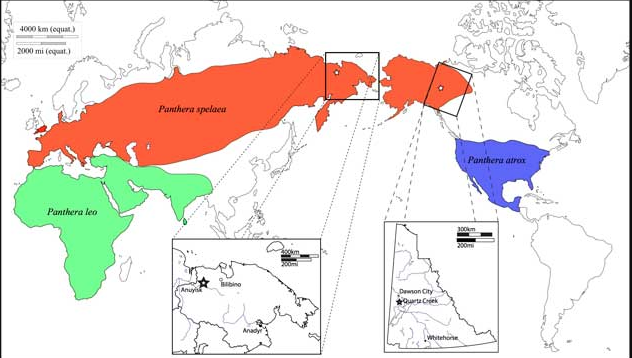
The Cave Lion was one of the largest felids (members of the cat family) to ever walk the Earth. Ranging across Europe, Asia, and eventually into North America (where it became the American Lion — but more on that in a future post), Panthera spelaea was enormous. Estimates based on skeletal remains put some individuals at significantly larger than the biggest modern lions. They were cold-adapted, heavily muscled, built for an Ice Age environment that demanded size and power.
In my world, Cave Leonites were the dominant Leonite population across much of Europe and northern Asia. Their range maps tell the story — these weren’t animals on the fringe of some distant territory. They were here. In Europe. For tens of thousands of years.
The Mosbach Lion (Panthera fossilis)
Even older than the Cave Lion, the Mosbach Lion — sometimes called the European Early Middle Pleistocene lion — was another massive big-cat species that roamed Europe and parts of Asia. In the Leonite framework of my world, Mosbach Leonites represent one of the earliest established populations on the European continent.
Over time — across many, many generations — Cave Leonites and Mosbach Leonites encountered each other. They interbred. The resulting admixture population inherited traits from both: the sheer size and cold-climate adaptation of the Cave Lion lineage combined with the deep, established European roots of the Mosbach line.
The Barbary Admixture
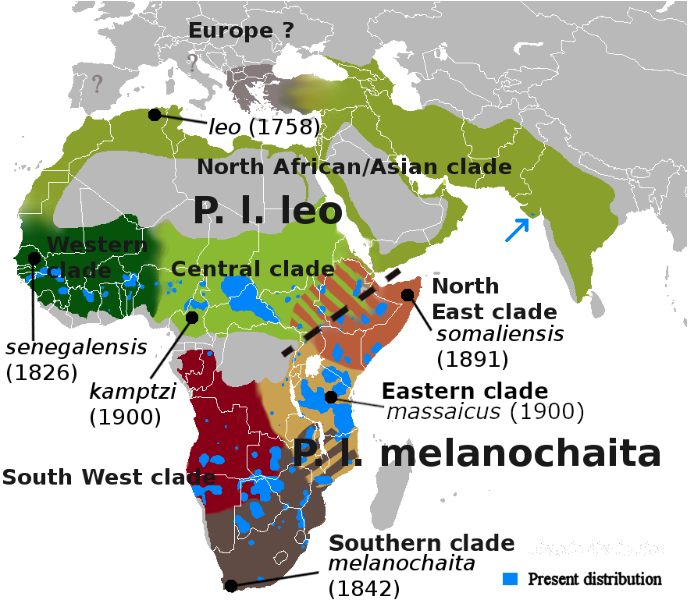
As climate patterns shifted and populations moved, this European cave/Mosbach admixture eventually came into contact with ancient Barbary Leonite populations from North Africa and the Mediterranean corridor. Another round of interbreeding. Another layer of genetic heritage.
The result is the modern Barbary Leonite — and it explains something that would otherwise be puzzling: why are Barbary Leonites, and particularly the European Leonite populations that descended from them, bigger than their purely African counterparts?
Because they carry the genetic legacy of giants. Cave Lion DNA doesn’t just disappear because the Cave Lion “went extinct.” It gets passed down, generation after generation, subtly expressing itself in body size, bone density, musculature, and cold-weather adaptation. Modern Barbary Leonites — Leo’s family included — aren’t anomalies. They’re the product of a very long, very complicated lineage that runs directly through Ice Age Europe.
The Lupenite Parallel: Dire Wolves, Arctic Wolves, and the Volorsky Family
The same principle applies to Lupenites — the wolf-based population in my world — and nowhere is it more dramatically illustrated than in the Volorsky family.
Dire wolves (Aenocyon dirus) and arctic wolves represent two of the ancient Lupenite lines that were absorbed into modern wolf populations rather than going extinct outright. Dire wolves were massively built — heavier, more powerful, with a crushing bite force that dwarfed modern wolves. Arctic wolves, meanwhile, contributed size, cold-weather adaptation, and the sheer physical presence that comes from surviving in some of the harshest environments on Earth.
These ancient lineages didn’t vanish. They live on in their descendants — and in the Volorsky family, those ancient genes express themselves in ways that are hard to miss.
Vladimir Volorsky: The Arctic Legacy
Standing at just under seven feet tall, Vladimir Volorsky’s height isn’t a random genetic quirk. It’s the expression of arctic wolf ancestry — the tall, long-limbed build that helped ancient arctic Lupenites cover vast distances across frozen tundra. His height is his heritage, written in bone.
Eugeni “The Tank” Volorsky: The Dire Wolf Legacy
Eugeni earned his nickname honestly. At 340 pounds of dense, functional muscle, he’s built like something that should be pulling a loaded sled rather than walking through a doorway sideways. That build comes from his dire wolf lineage — the heavily muscled, powerfully built ancient Lupenites whose descendants carry that blueprint in their genetics to this day.
Eugeni didn’t train himself into that body. He was born into it. The dire wolf DNA in his lineage predisposed him to that kind of mass in a way that no amount of gym time would replicate for someone without that ancestry.
Tino (Valentino): Cave Lion and Mosbach Ancestry in Full Expression
And then there’s Tino. Leo’s son. Over ten feet tall and approaching nine hundred pounds, with a bear-like build that makes even other large Leonites do a double-take.
Tino is what happens when the cave lion and Mosbach genetic inheritance reasserts itself in full force. He is, in many ways, closer in build to his ancient ancestors than to his modern contemporaries — a living throwback, not through mutation or anomaly, but through the simple genetics of deep ancestral heritage expressing itself with unusual strength. His size isn’t superhuman. It’s ancient-human. Or rather, ancient-Leonite.
Characters like Tino are a reminder that genetics doesn’t progress in a straight line toward smaller and more refined. Sometimes the ancient blueprint comes back. And when it does, it comes back hard.
Why This Approach Works: Ancient Genetics vs. Species Bloat
There’s a temptation in anthropomorphic worldbuilding — especially when you’re working with prehistoric species — to just add them as separate populations. Cave Lions are their own civilization. Dire wolves are their own faction. Mosbach lions are a distinct ethnic group. And suddenly your world has thirty different species all coexisting in the same city block, each with their own separate history and culture, and the whole thing collapses under the weight of its own complexity.
The genetics-absorption model solves this problem elegantly.
Instead of a separate cave lion civilization, cave lions are part of the history of modern Leonite populations. Their presence is felt not as a separate faction but as a genetic thread woven into the fabric of modern characters. You don’t need a cave lion character to tell a cave lion story — you just need a Leonite character who happens to be six-foot-nine with unusually large hands and a jaw that can crack a bone, and then you explain why.
This approach also makes your modern characters more interesting. They’re not just generic anthropomorphic animals — they’re palimpsests (documents that have been written over multiple times, where older layers still show through). Layers of history written in physical form. When you look at Tino, you’re not just looking at a big Leonite. You’re looking at the legacy of creatures that walked the glaciated plains of Pleistocene Europe. That’s a richer story than “he’s just a big guy.”
For writers using anthropomorphic species in their own worlds: consider this model before you reach for species bloat. Ask yourself — does this ancient species need to be its own distinct civilization? Or can their legacy live on more powerfully through the genetics of your modern characters?
Back to Geography: Why It Matters for Leo’s Heritage
So let’s return to where we started. Is it “whitewashing” to make Leo Italian-American?
No. And the genetic backbone explains exactly why.
Leonites in Europe aren’t immigrants who relocated from Africa in some recent or modern era. They have been on that continent since before the end of the last Ice Age. Their ancestors — the Cave Leonites, the Mosbach Leonites — ranged from the British Isles to Siberia. The Italian peninsula, the Iberian coast, the Mediterranean basin — these were Leonite territories long before any historical human civilization recorded them.
Leo’s family being Italian-American doesn’t mean lions were “relocated” from Africa to Italy. It means that a Leonite family from a population with tens of thousands of years of European history eventually emigrated to America, as millions of Italian humans did. That’s not erasure. That’s history.
The assumption that Leo should be “African” because modern lions are African species is the kind of thinking that only works if you ignore the genetic backbone entirely — if you pretend the past didn’t happen, that ancient species just blinked out of existence without leaving anything behind. But they didn’t. They left their descendants. They left their DNA. And they left us characters like Tino, who stands as living proof that the Ice Age never entirely ended.
Using This in Your Own Anthropomorphic World
If you’re building an anthropomorphic world and you want to incorporate ancient or extinct species, here are some principles worth considering:
Ancient species don’t have to be extinct or separate. Consider making them the genetic ancestors of your modern populations rather than a separate faction that still exists alongside them. Their legacy lives on in physical traits, cultural memory, and ancestral pride.
Use physical traits to tell ancestry stories. A character who is unusually large, unusually cold-tolerant, or unusually powerful can have that explained through ancient genetic heritage. It makes them more interesting and grounds the “why” in your world’s history.
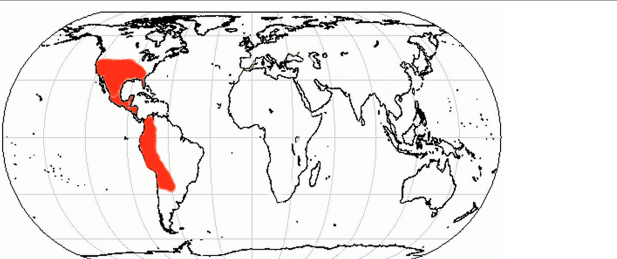
Research real prehistoric ranges. Cave lions really did range across Europe and into North America. Dire wolves really did exist in North America. Mosbach lions were real. The more you root your world’s prehistory in actual paleontology, the more grounded and credible it feels — and the more interesting questions it opens up.
Genetics explains geography better than migration. Instead of asking “why are there lions in Italy?” the better question is “why wouldn’t there be?” If you build the ancient prehistory correctly, the modern geography makes sense on its own terms — no hand-waving required.
Let the ancient express itself in modern characters. The most compelling characters often carry something ancient inside them. Whether it’s Tino’s cave lion scale, Eugeni’s dire wolf mass, or Vladimir’s arctic wolf height — those traits are stories waiting to be told.
The genetic backbone isn’t just a worldbuilding technique. It’s a way of honoring the real history of the natural world — one where extinction is rarely as clean as the textbooks suggest, where ancient things leave traces that outlast them by thousands of years, and where the past is never truly past.
Next time: The American Lion — and how an Ice Age giant that survived long enough to greet the first European explorers changed the course of Leonite history on an entire continent.